Denver's termite flights come early. Colorado State University's insect checklist for the metro area lists winged termites emerging in January and February and still swarming in early March. The state's termites are native subterranean kinds, and CSU Extension adds that damage by termites to structures in Colorado has not been very common compared with wetter or warmer parts of the US.
Key facts
- First flights, Metro Denver
- January/February (CSU checklist)
- Still flying
- Early March, "late winter" (CSU checklist)
- Statewide pattern
- Usually spring or fall (CSU)
- Native kinds
- Three or more subterranean species, Reticulitermes spp.
- Widest range
- R. tibialis, the aridland subterranean termite
- Behind most building damage
- Eastern subterranean termite (CSU)
A winter swarm season
You might expect termites to fly in summer. The Metro Denver checklist from CSU says otherwise: its January/February entry reads that winged reproductive stages begin to emerge and swarm, and its early March entry adds that they keep at it through late winter. Statewide, a separate CSU page says winged termites are usually produced in great numbers in the spring or fall. Years differ, so treat the dates as a rough guide.
Winged insects gathering at a basement window in February are worth a second look.
Species found in Colorado
Per CSU Extension's PlantTalk, Colorado is home to at least three native subterranean termites in the genus Reticulitermes, and they can be locally common. R. tibialis, known as the aridland subterranean termite, has the widest range; PlantTalk says it may be found throughout most of the state below about 7500 ft. Yet when a building does get damaged here, the usual culprit is the eastern subterranean termite.
Drywood termites are limited to a small area of Grand Junction, the page notes. CSU's bottom line is that termite damage to Colorado structures has not been very common compared with wetter or warmer parts of the US.
What to watch for
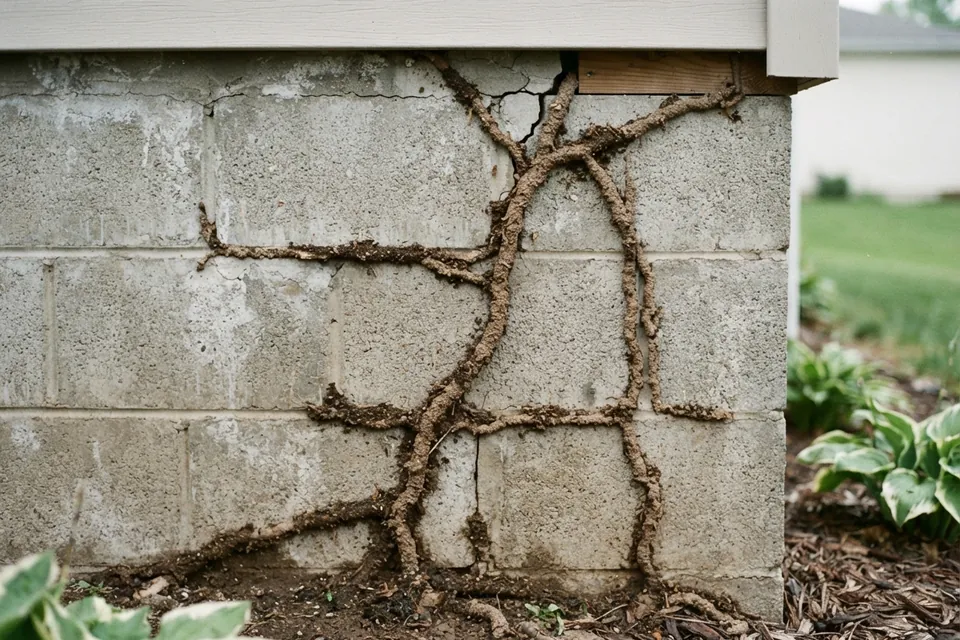
CSU's agricultural biology page names three indicators: mud tubes, frass and winged adults. A few details help you read them:
- Winged termites indoors mean an infestation is present, according to CSU.
- Discarded wings point to a new colony, since termites drop them once one forms.
- Moisture inside a mud tube marks it as active. An abandoned tube is dry and falls apart easily.
- Indoor spots that stay damp can show paint that cracks or blisters.
Outside, CSU points to the surfaces of slabs, sill plates, joists, garages, porches and crawl spaces, plus wood piles. Damp wood near a plumbing or roof leak is its own problem; see the water damage guide.
Want a price for your home? Call a local pest control company for a written quote.
Phone line opening soonYour next moves
- Hands off. Leave tubes and the wood around them intact for whoever inspects.
- Bag a few specimens. Seal some of the flying insects or their dropped wings in a jar or zip bag, and jot down when and where you found them.
- Book a licensed inspection. Look up the business on CDA's Pesticide Applicator Search before it comes out.
- No home treatment. Termite work is for a licensed applicator, not a weekend project.
National prices and Colorado's paperwork rules are on the treatment cost page.
When you call: 4 questions to ask
- Under what business name are you licensed with the Colorado Department of Agriculture?
- Which of your Qualified Supervisors covers this type of pest?
- Does the price include sealing entry points, or is that extra?
- Will you leave me a written notice of what you applied and when?
A fair written quote shows the pests and rooms or areas covered, whether it is one visit or a plan and how the plan bills, the method, the total, and any warranty and its renewal cost. Check any contractor's license on the Colorado Department of Agriculture's Pesticide Applicator Search before work starts.
What happens when you call
- You're connectedStraight to a local pest control company that serves your area and takes calls like yours.
- You get a priceDescribe the problem, ask for a written quote and their license number. No obligation.
Common questions
Do termites swarm in winter in Denver?
Yes, per CSU's Metro Denver checklist. Winged termites begin to emerge in January and February, and the early March entry says swarming continues in late winter. Timing varies by year.
Which termite damages Colorado buildings?
CSU Extension names the eastern subterranean termite as the species usually responsible. The aridland subterranean termite has the widest range in the state.
What if I see flying insects inside in late winter?
They may be termites. CSU says winged termites indoors indicate an infestation is present, so keep a sample and book an inspection by a licensed company.
Can I scrape away mud tubes?
Leave them. An inspector uses them, and CSU says moisture inside a tube shows it is still active.
Are termites a big problem in Colorado?
Less so than in many states. CSU says termite damage to structures in Colorado has not been very common compared with wetter or warmer parts of the US.
Related guides
Sources
- Colorado State University: Checklist of common insect related events, Metro Denver Area
- CSU Extension PlantTalk: Termites in Colorado
- Colorado State University Agricultural Biology: Termites
- Colorado Department of Agriculture: Pesticide Applicator Search
Costs are typical ranges. Your quote depends on your home. Rules and rebates change; check the original source before you rely on a figure. Something wrong? Tell us via the contact on the Impressum page.