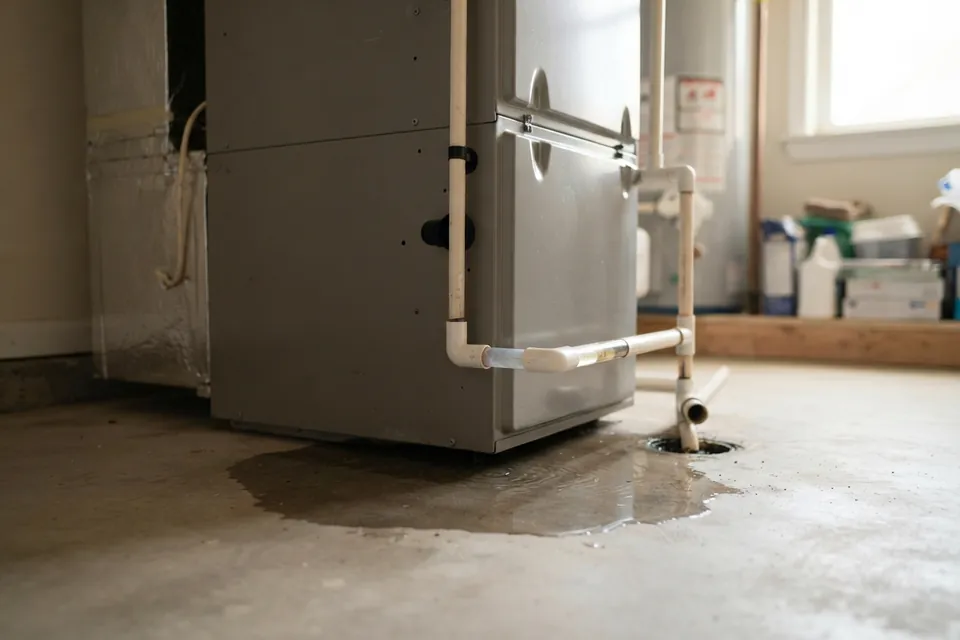
Switch cooling off at the thermostat, dry the area and look at the filter and the condensate drain. Water dripping outside from the drain line's end is normal; water pooling indoors isn't. A clogged drain line, a dirty filter that lets the coil ice and then melt, or a damaged drain pan are common causes. If water has reached ceilings or floors, treat it as water damage.
Key facts
- First
- Cooling off at the thermostat
- Then
- Dry the area; check the filter
- Normal
- Drip at the outside end of the drain line
- Not normal
- Water pooling around the indoor unit
- Ceiling stain under an attic unit
- Turn it off and call
- Contractor license
- North Carolina State Board of Examiners of Plumbing, Heating and Fire Sprinkler Contractors
Questions to ask yourself
Where is the water?
Outside, at the end of a small pipe near the foundation: that's the condensate line doing its job. Around the indoor unit, in a closet, basement or crawlspace: something's wrong. Through a ceiling below an attic unit: turn the system off right away, because the drain pan has likely filled.
Is the filter dirty?
A clogged filter can starve the indoor coil of airflow until it ices over. When the ice melts, the pan can overflow. Swap the filter and let the system sit with cooling off.
Is there ice?
Frost on the copper lines or the coil cabinet means set the system to Off with the fan On, and call a technician once it's thawed.
Has the drain line clogged?
Many systems have a cleanout cap on the drain line near the indoor unit. If water is backing up there, the line may be blocked. Some homeowners clear it with a wet-vac at the outside end; if you're unsure, leave it to a technician.
Want a price for your home? Call a local heating & cooling pro for a written quote.
Phone line opening soonWhy it shows up in summer here
Air conditioners pull water out of the air as they cool, and a Raleigh system runs long hours in July, when the daily normal high at the Raleigh-Durham airport station is 91 °F (NWS, 1991–2020). That's a lot of water through one small drain.
If parts need replacing
A drain pan or a pump can often be repaired. Replacing the equipment itself is different: the City of Raleigh lists HVAC replacement among projects that require a permit but do not require plans. HVAC contractors are licensed by the North Carolina State Board of Examiners of Plumbing, Heating and Fire Sprinkler Contractors, searchable at public.nclicensing.org.
If water got into the house
Wet drywall, carpet or ceiling below an attic unit needs drying. See the first hour after a leak, and photograph everything before cleanup.
What a repair usually costs
National ranges from cost publishers, not Raleigh quotes. The fault decides the price, so ask for it in writing before work starts.
When you call: 4 questions to ask
- Is the City of Raleigh permit for this HVAC replacement in your price, and who applies for it?
- What's your license number with the North Carolina State Board of Examiners of Plumbing, Heating and Fire Sprinkler Contractors?
- Which rebate does this quote assume, and did you check that program's current page?
- If this is new equipment rather than a replacement, will you prepare the plot plan the City asks for?
A fair written quote shows the equipment and its efficiency rating, the City permit, any rebate paperwork, removal of the old unit and the warranty. Check any contractor's license on the state plumbing, heating and fire sprinkler board's license search before work starts.
What happens when you call
- You're connectedStraight to a local heating & cooling pro that serves your area and takes calls like yours.
- You get a priceDescribe the problem, ask for a written quote and their license number. No obligation.
Common questions
Is it normal for an AC to drip water?
Water at the outside end of the condensate drain line is normal. Water pooling around the indoor unit isn't.
Why is my AC leaking inside the house?
Common causes are a clogged condensate drain, a dirty filter that lets the coil ice and then melt, or a cracked or overflowing drain pan.
Should I keep running the AC if it's leaking?
No. Turn cooling off, dry the area, check the filter, and call a technician if the leak doesn't stop.
Related guides
Sources
- National Weather Service Raleigh: KRDU 1991–2020 daily climate normals (Raleigh-Durham International Airport)
- City of Raleigh Planning and Development: How to get a residential permit (updated July 13, 2026)
- State Board of Examiners of Plumbing, Heating and Fire Sprinkler Contractors: Consumer awareness
- Johnston County Inspections: licensing boards and contractor searches
Costs are typical ranges. Your quote depends on your home. Rules and rebates change; check the original source before you rely on a figure. Something wrong? Tell us via the contact on the Impressum page.