Stop running water in the house so you don't add to it, and keep people and pets out of the sewage. In Raleigh, you're responsible for the sewer line from your home to where it joins the City's main; the City maintains the mains in the public right-of-way. The NC Department of Insurance says losses from water backup are not covered under a standard homeowners policy unless you've added an endorsement.
Key facts
- First
- Stop all water use: toilets, sinks, washer, dishwasher
- Then
- Stay out of the sewage; keep away from outlets in wet areas
- Your line
- From the house to the point it joins the City's main sewer line
- City's line
- Main sewer lines in the public right-of-way
- Insurance
- Water backup not covered under a standard homeowners policy; endorsement available from most insurers (NCDOI)
- Insurance questions
- NCDOI Consumer Services, (855) 408-1212
- Stop using water. No flushing, no showers, no dishwasher or washing machine. Every gallon you send down has nowhere to go but back up.
- Keep clear and stay safe. Sewage carries germs. Keep children and pets out, wear gloves and boots if you must go near, and don't touch outlets or cords in a wet area.
Sewage coming up a drain or toilet? Call a plumber who clears sewer lines now, then work through the rest of the list.
Phone line opening soonHave this ready when you call
- Your address
- Where the water is and whether the main is off
- When it started
- Ask the neighbours. If houses on both sides have the same trouble, the City's main may be involved. Raleigh Water is responsible for breaks in water and sewer mains in the street; contact it through the City's water service page.
- Photograph everything. The drain, the water level, damaged floors and belongings, before anything is cleaned up.
- Call your insurer. Ask whether your policy has a water backup endorsement.
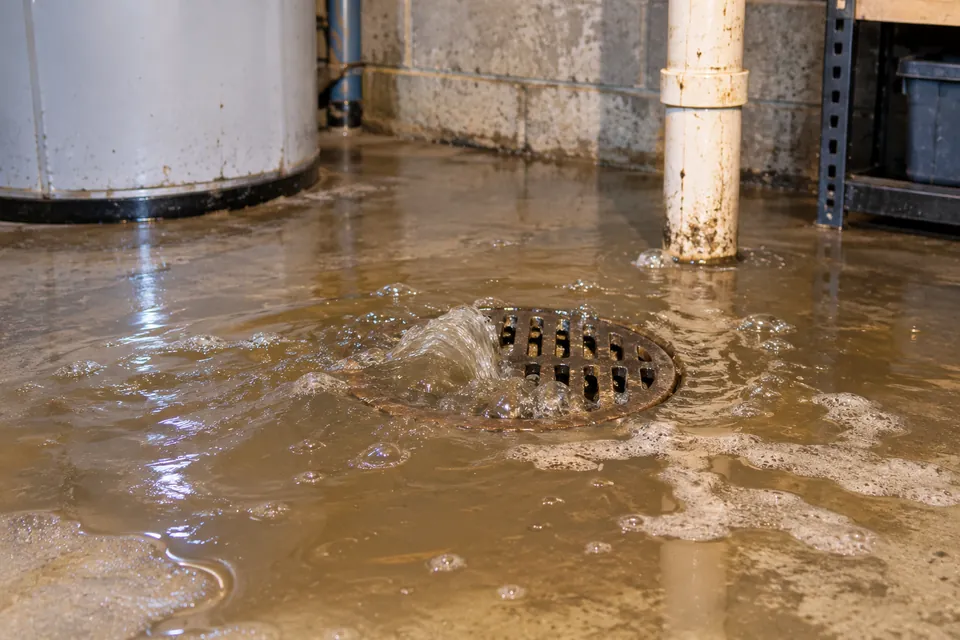
Whose line is it?
The City's Know Your Pipes page draws the line this way: you're responsible for the portion of the sewer line that runs from your home to the point where it connects to the City's main sewer line, and the City maintains the main lines within the public right-of-way. In practice, a blockage in your house drain or your lateral is a plumber's job at your expense. A problem in the main is the City's.
| What you notice | Points toward |
|---|---|
| One fixture slow or backing up | A clog in that fixture's drain |
| Several drains at once, lowest drain overflowing | Your sewer lateral |
| Neighbours on the same street affected | Possibly the City's main |
The insurance gap
The NC Department of Insurance states: "Losses from water backup and sump overflow are not covered under your homeowners insurance policy." It adds that this coverage is available through most insurance companies as an endorsement. If you're not sure what your policy includes, NCDOI's Consumer Services Division answers questions at (855) 408-1212, weekdays from 8 a.m. to 5 p.m.
For drying and cleanup after a backup, see flooded house.
What a repair usually costs
National ranges from cost publishers, not Raleigh quotes. The fault decides the price, so ask for it in writing before work starts.
When you call: 4 questions to ask
- The City lists water heater replacement as needing a permit: will you apply, or are you relying on the G.S. 160D-1110(a) exemption, and why?
- Is this leak on my side of the property line or the City's?
- For a gas heater, will you leak test the gas piping when you're done?
- Is the service-call fee credited if I go ahead?
A fair written quote shows the heater or parts, labor, any permit, haul-away of the old tank and the written warranty. Check any contractor's license on the state plumbing, heating and fire sprinkler board's license search before work starts.
What happens when you call
- You're connectedStraight to a local plumber that serves your area and takes calls like yours.
- You get a priceDescribe the problem, ask for a written quote and their license number. No obligation.
Want a price for your home? Call a local plumber for a written quote.
Phone line opening soonCommon questions
Who is responsible for a sewer backup in Raleigh, me or the City?
It depends where the blockage is. You're responsible for the sewer line from your home to the point where it connects to the City's main; the City maintains the main lines in the public right-of-way.
Does homeowners insurance cover a sewer backup in North Carolina?
The NC Department of Insurance says losses from water backup and sump overflow are not covered under a homeowners policy, but coverage is available as an endorsement from most insurers.
Is it safe to clean up sewage myself?
Small amounts can be handled with gloves, boots and disinfectant, but sewage carries germs. For anything beyond a small spill, or if it has soaked into floors or walls, a cleanup company is the safer choice.
Related guides
Sources
- City of Raleigh: Know your pipes
- City of Raleigh: Water service FAQ
- NC Department of Insurance: Optional homeowners coverage
- NC Department of Insurance: Have a question about your insurance or claim? (March 11, 2026)
Costs are typical ranges. Your quote depends on your home. Rules and rebates change; check the original source before you rely on a figure. Something wrong? Tell us via the contact on the Impressum page.