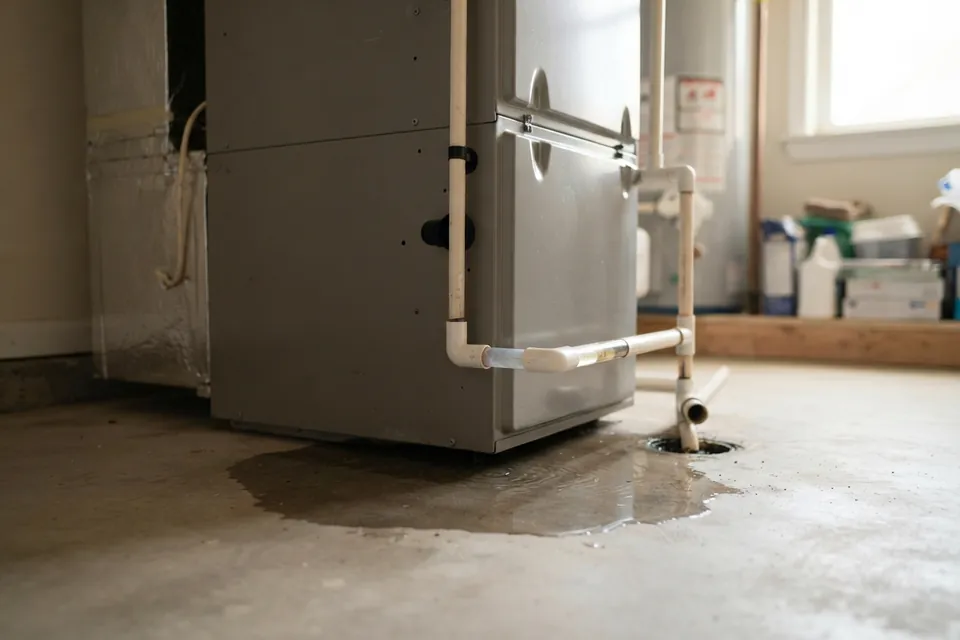
Water around the indoor half of an air conditioner is nearly always condensation that failed to drain. Turn cooling off at the thermostat so no more forms, soak up what is there, and look at the filter and the drain outlet. A blocked drain is a routine service call. Ice on the unit, a wet ceiling or water near wiring is a reason to stop and call an AC contractor.
Key facts
- First move
- Cooling off at the thermostat
- Rule out
- Dirty filter, blocked drain outlet, unplugged condensate pump
- Stop and call
- Ice, a wet ceiling, water near wiring, a leak that returns
- AC contractor
- Works under a Denver mechanical supervisor certificate
- Soaked ceiling or floor
- Water damage restoration: $1,200–$5,000 (Fixr national average range)
- Insurance questions
- Colorado Division of Insurance consumer services, 303-894-7490
Rule out the simple things
- Turn the thermostat from Cool to Off: the coil stops making condensation within minutes, so the puddle stops growing.
- Mop up and lay towels: standing water wicks into flooring, baseboards and the platform the unit sits on.
- Take a look at the filter: a blocked filter chills the coil until it freezes, and the melt can be more than the pan was built to hold.
- Trace the white plastic drain pipe to where it ends: an outlet buried in mulch, kinked, or plugged with slime at the tip backs water up to the unit.
- Wipe away anything blocking that open end: clearing the visible outlet is safe, while forcing tools or chemicals up the pipe can crack a fitting.
- See whether a small pump box beside the unit is plugged in: systems that cannot drain downhill rely on a condensate pump, and a pulled plug is all it takes.
- Peek at the metal pan under an attic unit without touching it: water sitting in that backup pan confirms the main drain is blocked.
- Photograph any stain or wet patch: pictures taken now help both the technician and, if it comes to a claim, the insurer.
Want a price for your home? Call a local heating & cooling pro for a written quote.
Phone line opening soonSigns it is not simple
- Ice coats the copper lines or the coil housing.
- Water has come through a ceiling, or the drywall feels soft.
- The puddle reaches an outlet, a cord, or the unit's own wiring.
- The backup pan is rusted through or overflowing.
- The drain outlet is clear and the leak returns as soon as cooling restarts.
- The air from the vents is warm as well; work through AC not cooling.
A technician can clear the drain line properly, test the safety float and find out why the coil froze. Those jobs involve opening the unit, so they are outside the safe list.
Who does what in Denver
An AC contractor deals with the unit. Denver's Contractor Licensing office issues mechanical supervisor certificates, and the list includes “Heating, Ventilating, A/C – Residential Only”. A fair question on the phone is who holds the certificate the company operates under.
A water damage company deals with what got wet. If water sat in a ceiling, carpet pad or subfloor, drying it is a separate trade from fixing the air conditioner. Fixr's national average range for water damage restoration is $1,200 to $5,000; this guide has no Denver figure. The first steps are laid out on the water damage page.
Your insurer decides coverage. The Colorado Division of Insurance says homeowners policies may cover water damage caused by an interior broken pipe. A condensate overflow is a different event and that page does not address it, so read your policy and ask your agent before assuming either way. To talk to Division of Insurance staff about how an insurer is handling your claim, call 303-894-7490 (Option 3 for property).
The city comes in only for new equipment. “Residential A/C” sits on Denver's quick permit list for single-family and duplex homes. Clearing a drain is a service visit, and this guide has no city rule requiring a permit for it. If the diagnosis becomes a new system, Fixr's national range is $5,000 to $12,000 installed, and the permit should appear on the estimate.
Why it shows up in summer. The normal July high in National Weather Service monthly summaries for Denver is 89.9 °F. Long run times in the hottest weeks mean the most condensation, so a drain that was half blocked in June tends to overflow in July.
What a repair usually costs
National ranges from cost publishers, not Denver quotes. The fault decides the price, so ask for it in writing before work starts.
When you call: 4 questions to ask
- Which Denver mechanical supervisor certificate covers this job, and who pulls the quick permit?
- Is the new furnace 95% AFUE or better, so it qualifies for Xcel Energy's rebate?
- For a heat pump: will you claim the Colorado Heat Pump Tax Credit and show the discount on my invoice?
- Will you size it with a load calculation for our altitude and winters?
A fair written quote shows equipment model and efficiency, the permit, rebate and tax-credit paperwork, and parts and labor warranty. Check any contractor's license on the DORA license lookup before work starts.
What happens when you call
- You're connectedStraight to a local heating & cooling pro that serves your area and takes calls like yours.
- You get a priceDescribe the problem, ask for a written quote and their license number. No obligation.
Common questions
Is it normal for an AC to drip water?
Dripping from the drain outlet outdoors or at a floor drain is normal. Water on the floor by the indoor unit, in the backup pan or on a ceiling is not, and usually means the drain is blocked or the coil froze.
Can I still run my AC if it is leaking water?
It is better to leave cooling off until the cause is found. Every hour of running adds condensation, and the water has nowhere to go but the floor or ceiling.
Who fixes a leaking air conditioner in Denver?
An AC contractor fixes the unit. If drywall, insulation or flooring got soaked, a water damage company handles the drying.
Does homeowners insurance cover an AC leak in Colorado?
This guide cannot say for your policy. The Colorado Division of Insurance notes that policies may cover damage from an interior broken pipe; ask your insurer how it treats a condensate overflow.
Related guides
Sources
- Denver Contractor Licensing: Mechanical supervisor certificates
- Denver Community Planning and Development: Quick permits
- Fixr: Water damage restoration cost (national)
- Fixr: Air conditioner installation cost (national)
- Colorado Division of Insurance: My homeowners insurance doesn't cover what?
- Colorado Division of Insurance: Before you schedule an appointment or file a complaint
- National Weather Service Denver/Boulder: July 2026 monthly climate summary
Costs are typical ranges. Your quote depends on your home. Rules and rebates change; check the original source before you rely on a figure. Something wrong? Tell us via the contact on the Impressum page.