An air conditioner that runs without cooling often has an ordinary cause: the thermostat is in the wrong mode, the filter is blocked, one of its two breakers tripped, or the outdoor unit is smothered by debris. Work through those from the outside of the equipment only. If the air is still warm, or you see ice, shut the system off and call an AC contractor. Denver's normal July high is 89.9 °F.
Key facts
- Rule out first
- Thermostat mode, filter, both breakers, outdoor unit, vents
- Ice on the lines
- System off, fan on, then call a technician
- Power out too
- Xcel Energy 1-800-895-1999 (residential)
- Permit
- “Residential A/C” is on Denver's quick permit list
- New central AC
- $5,000–$12,000 installed (national, Fixr)
- Smart thermostat rebate (2026)
- $50 from Xcel Energy for an ENERGY STAR model eligible for AC Rewards
- Normal July high
- 89.9 °F (National Weather Service monthly summary)
Rule out the simple things
- Switch the thermostat to Cool and the fan to Auto: with the fan on On, the blower pushes unchilled air between cycles and the house feels as if nothing works.
- Drop the setting below the room temperature: cooling does not begin until the target sits under what the thermostat reads.
- Change a grey, fuzzy filter: restricted airflow lets the indoor coil get too cold and ice over, which blocks the air completely.
- Find both AC breakers and reset a tripped one once: the indoor and outdoor halves usually sit on separate breakers, and a blower can run happily while the outdoor half has no power.
Settings, filter, breakers and the outdoor unit all look right, yet the house keeps warming? Phone a local AC company, then read the rest.
Phone line opening soonHave this ready when you call
- Your address
- What the system is doing (no heat, no cooling, a noise, a leak)
- Roughly how old the unit is
- Go out and listen to the outdoor unit: a silent unit, or one that hums with a still fan, tells the technician a great deal before the truck leaves the shop.
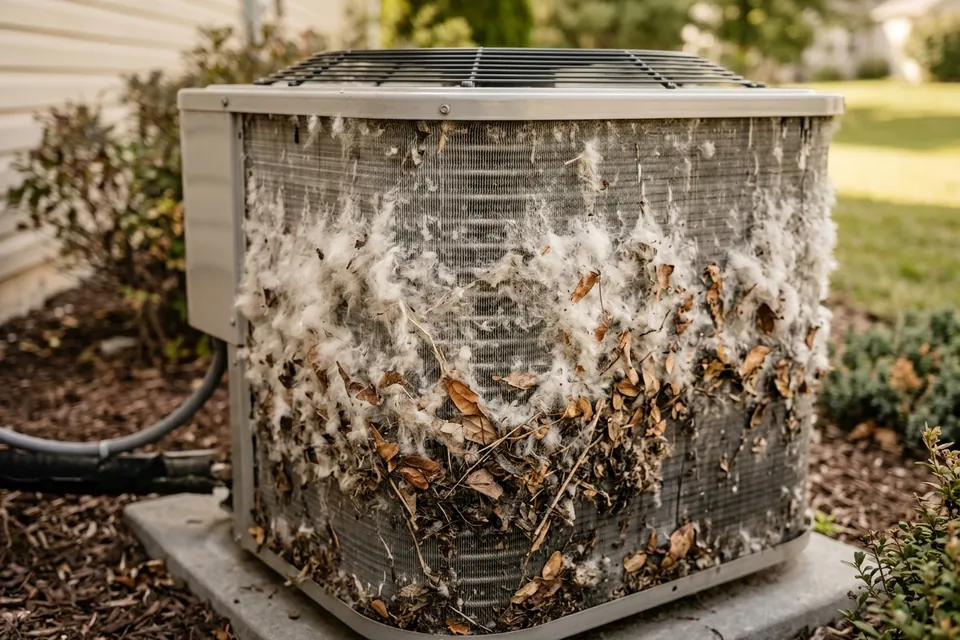
- Pull leaves, cottonwood fluff and stored items away from its sides: the unit sheds the house's heat through those fins, and it cannot do that through a blanket.
- Open every supply vent: closing vents in unused rooms raises pressure in the ducts and cuts the air reaching the rooms you care about.
- Check the copper line for frost: ice means the system needs to be off with the fan on until it melts, and it means the cause still has to be found.
Signs it is not simple
- Frost or ice appears on the copper line or the indoor unit, or it comes back after thawing.
- A breaker trips again after the single reset.
- The outdoor fan does not spin, or the unit clicks, buzzes or grinds.
- There is a hot electrical smell at the equipment or the thermostat.
- Water is dripping from the indoor unit or staining a ceiling; see AC leaking water.
- All the easy causes are ruled out and the supply air is no cooler than the room.
None of what comes next is homeowner work. Refrigerant, capacitors and anything behind a screwed-on cover belong to a technician with the right gauges and training.
Who does what in Denver
Xcel Energy supplies the electricity. If the air conditioner stopped at the same moment as the lights, the trouble is upstream of your house. The residential number in Xcel Energy's outage release is 1-800-895-1999. When only the AC circuits are dead, the problem is on your side and an AC contractor or electrician is the right call.
An AC contractor fixes the equipment. In Denver, mechanical supervisor certificates come from the city's Contractor Licensing office. “Heating, Ventilating, A/C – Residential Only” is one of the titles on its list. Ask which certified supervisor the company works under. Denver's page offers no public lookup; ask the company for its Denver certificate number and check with Denver Contractor Licensing at (720) 865-2770.
Denver issues the permit. “Residential A/C” appears on the city's quick permits page among single-family and duplex work that can be issued without plan review. That applies when equipment is being installed or replaced. This guide has no city rule to quote for a small repair, so ask the contractor, or ask Community Planning and Development at 720-865-2700.
National prices, not Denver prices. No verified Denver price for an AC repair is available to this guide. For a complete new central air conditioner, Fixr's national range is $5,000 to $12,000 installed. Treat it as a yardstick for a replacement quote and nothing more. The heating and cooling page covers replacement choices, including heat pumps.
A rebate worth knowing. Xcel Energy's 2026 rebate summary lists $50 for an ENERGY STAR smart thermostat that is eligible to enroll in AC Rewards. If the old thermostat turns out to be the fault, that is money toward the new one. Other 2026 amounts are on the rebates page.
Summer heat. The normal July high in National Weather Service summaries is 89.9 °F. If someone at home is elderly, very young or ill, get them somewhere cool while the repair is arranged. Call 911 for confusion, fainting or other signs of heat illness.
What a repair usually costs
National ranges from cost publishers, not Denver quotes. The fault decides the price, so ask for it in writing before work starts.
When you call: 4 questions to ask
- Which Denver mechanical supervisor certificate covers this job, and who pulls the quick permit?
- Is the new furnace 95% AFUE or better, so it qualifies for Xcel Energy's rebate?
- For a heat pump: will you claim the Colorado Heat Pump Tax Credit and show the discount on my invoice?
- Will you size it with a load calculation for our altitude and winters?
A fair written quote shows equipment model and efficiency, the permit, rebate and tax-credit paperwork, and parts and labor warranty. Check any contractor's license on the DORA license lookup before work starts.
What happens when you call
- You're connectedStraight to a local heating & cooling pro that serves your area and takes calls like yours.
- You get a priceDescribe the problem, ask for a written quote and their license number. No obligation.
Want a price for your home? Call a local heating & cooling pro for a written quote.
Phone line opening soonCommon questions
Why is my AC running but not cooling the house?
The usual easy causes are a thermostat set to Heat or fan-only, a clogged filter, a tripped breaker on the outdoor unit, or debris packed against the outdoor coil. If none of those is it, switch the system off and have a technician diagnose it.
Should I turn my AC off if it is not cooling?
Yes, once the simple checks are done. Running it with ice on the coil or a stalled outdoor fan can cause further damage. Set the thermostat to Off; leave the fan on if there is ice to melt.
How much does AC repair cost in Denver?
This guide has no verified Denver repair figure. Fixr's national range for a new installed central air conditioner is $5,000 to $12,000, which helps only when the question is replacement.
Who do I call for AC repair in Denver?
An AC contractor working under a Denver mechanical supervisor certificate. If the whole house lost power, call Xcel Energy's residential line at 1-800-895-1999 first.
Related guides
Sources
- National Weather Service Denver/Boulder: July 2026 monthly climate summary
- Xcel Energy newsroom: outage preparation release, December 2025
- City and County of Denver: Denver-Xcel partnership
- Denver Contractor Licensing: Mechanical supervisor certificates
- Denver Community Planning and Development: Quick permits
- Denver Community Planning and Development: Contact us
- Fixr: Air conditioner installation cost (national)
- Xcel Energy: 2026 Colorado Residential Rebate Summary
Costs are typical ranges. Your quote depends on your home. Rules and rebates change; check the original source before you rely on a figure. Something wrong? Tell us via the contact on the Impressum page.