Around Denver, yellowjacket and hornet trouble builds through summer: CSU's Metro Denver checklist says nest size and nuisance problems peak in early September. CSU Extension's guidance is to deal with bees and wasps only when they actually cause difficulties, and to let a beekeeper relocate a badly placed hive rather than kill it.
Key facts
- Yellowjacket and hornet peak
- Early September (CSU Metro Denver checklist)
- Honey bee swarms
- Peak in late May (CSU Metro Denver checklist)
- Mud daubers
- In general harmless to humans (CSU)
- Wasp nest removal
- $325–$450, national average $390 (Fixr)
- Hornet nest removal
- $450 (Fixr, national)
- Severe sting reaction
- Call 911
Two seasons to know
Late spring: CSU's Metro Denver insect checklist marks late May as the peak of honey bee swarming. Late summer: the same checklist puts the peak of yellowjacket and hornet nest size, and of the nuisance that comes with it, in early September. PlantTalk, CSU Extension's homeowner site, calls yellowjackets ground-dwelling wasps that turn very aggressive in the late summer and fall.
Which insect is it?
- Yellowjackets: wasps that nest underground.
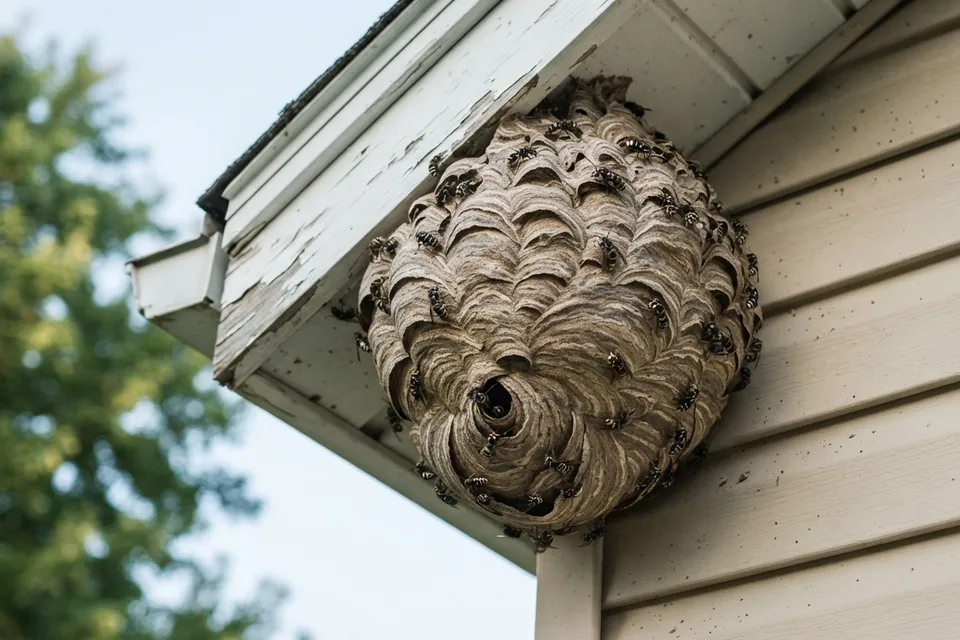
- European paper wasps: their papery nests sit under eaves or tucked into small cavities.
- Mud daubers: CSU says that in general they are harmless to humans.
- Bees: typically calm, unless an unwary gardener happens to grab one.
Leave it, move it or remove it
CSU's rule of thumb is that bees and wasps should be managed only when they present difficulties. A paper wasp nest high on a quiet wall may be fine to ignore. Yellowjackets nesting beside a walkway, a deck or the swing set are another matter, and that is the point to bring in a licensed company. Look the business up on CDA's Pesticide Applicator Search before it does any work.
Honey bees are the exception to removal. If a hive sits too close to a building entrance or where children play, PlantTalk notes that many beekeeping companies or organizations will relocate the colony somewhere desirable. Killing bee colonies is something it does not recommend.
Want a price for your home? Call a local pest control company for a written quote.
Phone line opening soonSafety basics near a nest
- Keep your distance from an active nest. Don't swat it, spray it or knock it down.
- Leave a ground opening alone; don't stuff or flood it.
- Bring kids and pets indoors until the nest is handled.
- Anyone using a product should follow its label exactly and keep everyone else clear.
Prices, national
Fixr lists $325 to $450 as its national average range for taking out a wasp nest, and $390 as the national average. That figure assumes the nest is inspected and taken down from a spot that is easy to reach. Fixr's figure for a hornet nest is $450.
Stings and pesticide exposure
Trouble breathing or a severe reaction after a sting is a 911 call. If a pesticide gets on skin, into eyes or is swallowed, phone the poison help center, 1-800-222-1222, and have the product label with you.
When you call: 4 questions to ask
- Under what business name are you licensed with the Colorado Department of Agriculture?
- Which of your Qualified Supervisors covers this type of pest?
- Does the price include sealing entry points, or is that extra?
- Will you leave me a written notice of what you applied and when?
A fair written quote shows the pests and rooms or areas covered, whether it is one visit or a plan and how the plan bills, the method, the total, and any warranty and its renewal cost. Check any contractor's license on the Colorado Department of Agriculture's Pesticide Applicator Search before work starts.
What happens when you call
- You're connectedStraight to a local pest control company that serves your area and takes calls like yours.
- You get a priceDescribe the problem, ask for a written quote and their license number. No obligation.
Common questions
When do yellowjackets get bad in Denver?
CSU's Metro Denver checklist puts the peak of yellowjacket and hornet nest size and nuisance problems in early September.
When do honey bees swarm here?
The same CSU checklist lists late May as the peak of honey bee swarming.
Do I need to remove mud daubers?
Only if they cause difficulties. CSU Extension says mud daubers are in general harmless to humans, and bees and wasps should be managed only when they present difficulties.
A hive is next to my front door. Who do I call?
PlantTalk says many beekeeping companies or organizations will move a colony to another location. It does not recommend killing bee colonies.
How much is wasp or hornet nest removal?
Fixr's national average range for a wasp nest is $325 to $450, with a $390 average. It lists a hornet nest at $450.
Related guides
Sources
- CSU Extension PlantTalk: Nuisance bees and wasps
- Colorado State University: Checklist of common insect related events, Metro Denver Area
- Fixr: Wasp nest removal cost (national)
- Colorado Department of Agriculture: Pesticide Applicator Search
- CSU Extension PlantTalk: Pesticides, poisoning and first aid
Costs are typical ranges. Your quote depends on your home. Rules and rebates change; check the original source before you rely on a figure. Something wrong? Tell us via the contact on the Impressum page.