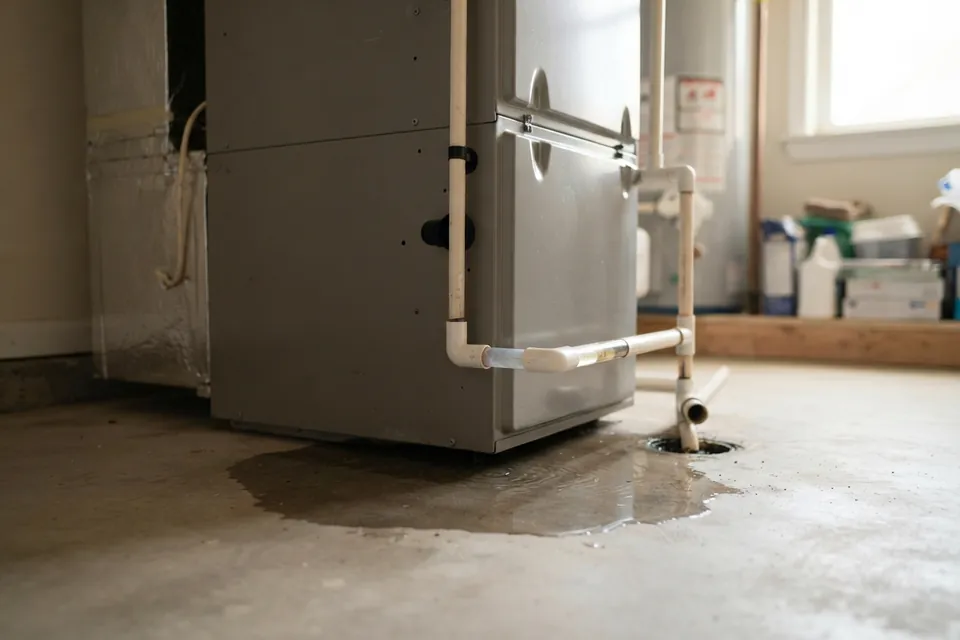
Water by the indoor unit nearly always means condensation isn't draining away. Set the thermostat to Off so no more forms, mop up, and move anything stored underneath. Then replace a dirty filter and look at where the drain pipe ends outdoors. If the puddle returns, or water has reached a ceiling, call an HVAC technician. Nashville's normal July high is 90.9 °F, so systems here make plenty of condensate.
Key facts
- First move
- Thermostat to Off
- Usual cause
- Blocked condensate drain or an iced coil
- Safe checks
- Filter, drain outlet outdoors, visible drain pan
- Repair permit
- Not needed for a condenser or furnace repair on Metro's permit chart
- Ceiling or wall wet?
- Treat it as water damage as well
- Normal July high
- 90.9 °F at Nashville International Airport (NWS)
Short version: stop the cooling, dry the area, check the filter and the drain outlet, and let a technician deal with anything inside the cabinet.
What you can check
- Switch cooling off. At the thermostat, choose Off. Condensation only forms while the coil is cold, so this alone slows the drip.
- Protect what's below. Towel up the puddle, slide boxes and rugs clear, and set a tray or baking dish under the drip point. In an attic installation, look at the ceiling beneath for a stain or a soft spot.
- Look at the filter. A filter packed with dust starves the coil of air, the coil ices over, and the ice later melts onto the floor. Change it if it's dirty.
- Find the drain outlet. A small plastic pipe usually exits near the outdoor unit or along the foundation. With the AC running it should drip steadily. Wipe away mud, mulch or insect nests from the open end. A wet/dry shop vacuum held over that end for a minute is a common homeowner fix.
- Glance at the pan. Many indoor units sit over a metal or plastic tray. Standing water in it confirms a drain problem. Look only; don't unscrew panels to reach it.
- Restart and watch. Once things are dry, set the thermostat back to Cool and check the spot again later. Dry floor and a dripping outlet outdoors means you're done.
Want a price for your home? Call a local heating & cooling pro for a written quote.
Phone line opening soonWhat not to touch
Leave the coil cabinet closed, and don't pour bleach or drain cleaner into fittings you'd have to dismantle. The float switch wired near the pan is a safety cut-out; bypassing it lets the pan overflow. Refrigerant is not something to add or test at home, and low refrigerant is one reason coils freeze.
Stop and call a pro when:
- water shows up again after you've cleared the outlet;
- the coil or the copper pipe keeps icing;
- the drip is landing on wiring, a furnace control board or a ceiling light;
- the pan is rusted through or cracked;
- you can't locate where the drain line ends.
The Nashville part
Why it's common here. With a normal July high of 90.9 °F recorded at the airport, cooling systems run for long stretches and pull a lot of moisture out of indoor air. All of that leaves through one narrow drain line, which is why a small clog shows up as a puddle.
Permit. Metro's permit chart lists furnace or condenser repair as not requiring a permit. Clearing a drain or swapping a pan is repair work, though the chart (issued in 1989, last revised in 2011) has no line naming it; Metro Codes and Building Safety can confirm on 615-862-6500. A replacement unit does need a gas/mechanical permit.
License. Tennessee's contractor board states that the state has no HVAC license for projects under $25,000, so a small repair won't show up as a state HVAC credential. Metro Nashville holds its own Master Mechanical and HVAC&R contractor exams; ask the company for its Metro license and, for bigger jobs, look up the state contractor license on Tennessee's license search. That search is for state licenses; for Metro trade licenses, ask Metro Codes Permit Issuance at 615-862-6517.
Cost. No local price for a drain cleaning or pan replacement appears in this guide; the table below gives a national range for clearing the drain. Ask for the figure up front and in writing.
If the ceiling got wet. Drying drywall and insulation is a different trade from fixing the AC. Fixr's national average range for water damage restoration is $1,200 to $5,000; the steps are on water damage: what to do first.
Not the water utility. Metro Water Services' 615-862-4600, option 3 line is for water emergencies and leak reports; condensate from your own equipment isn't a utility matter.
What a repair usually costs
National ranges from cost publishers, not Nashville quotes. The fault decides the price, so ask for it in writing before work starts.
When you call: 4 questions to ask
- What SEER2 rating is this heat pump, and does it reach the $800 or the $500 TVA EnergyRight tier?
- Does Metro Codes need a permit for this replacement, and is it in the price?
- Which Tennessee and Metro licenses do you hold for this job size?
- How did you size the system for this house?
A fair written quote shows the unit and its rating, any Metro permit, rebate paperwork, removal of the old unit and warranty. Check any contractor's license on the Tennessee license search before work starts.
What happens when you call
- You're connectedStraight to a local heating & cooling pro that serves your area and takes calls like yours.
- You get a priceDescribe the problem, ask for a written quote and their license number. No obligation.
Common questions
Why is my AC leaking water inside the house?
The condensate drain is probably blocked, or the coil froze and is now thawing. Turn cooling off, change the filter and clear the drain outlet outdoors. A leak that comes back needs a technician.
Is it safe to run the AC while it's leaking?
No. Leave it off until the drain is clear. Running it keeps producing water, which can soak a ceiling or reach electrical parts.
Who fixes a leaking air conditioner in Nashville, a plumber or an HVAC company?
An HVAC company. The drain line is part of the cooling system. A plumber is only needed if the water turns out to be from a supply pipe.
Does homeowners insurance cover an AC leak?
This guide has no Tennessee fact on that. Photograph the damage, read your policy and ask your insurer. Tennessee's Consumer Insurance Services answers questions and mediates complaints at (615) 741-2218; formal complaints are filed online.
Related guides
Sources
- National Weather Service Nashville: Nashville (BNA) climate normals and records
- Metro Codes: Building Permit Required? chart
- Metro Codes and Building Safety: Contact information
- Tennessee Board for Licensing Contractors: Consumer tips
- Tennessee Department of Commerce and Insurance: License search
- Fixr: Water damage restoration cost (national)
- Metro Water Services: Customer information and emergency line
- Tennessee Department of Commerce and Insurance: Insurance Division contact
- Tennessee Department of Commerce and Insurance: Complaint instructions
Costs are typical ranges. Your quote depends on your home. Rules and rebates change; check the original source before you rely on a figure. Something wrong? Tell us via the contact on the Impressum page.