Start with what you can reach safely: confirm the thermostat says Cool, swap a clogged air filter, reset a tripped breaker one time, and see that the outdoor unit is running with nothing piled against it. If warm air keeps coming, switch the system off and have an AC technician look at it. Houston's normal July high is 94.5 °F, so plan for a cooler place to wait.
Key facts
- 1. Thermostat
- Cool mode, set below the room reading, fresh batteries
- 2. Air filter
- Replace it if it looks grey or matted
- 3. Breaker
- Reset a tripped one a single time
- 4. Outdoor unit
- Fan turning, sides clear of leaves and clutter
- Repair permit
- City requires one to repair or replace a condensing unit
- License to ask for
- Texas ACR contractor license (TDLR)
- New central AC
- $5,000–$12,000 installed (national, Fixr)
- Normal July high
- 94.5 °F at Bush Intercontinental (NWS 1991-2020)
- Read the thermostat. It should be on Cool, with the fan on Auto and the target a few degrees under the temperature shown for the room. A blank or dim screen often just means the batteries are spent.
- Pull the air filter and hold it to the light. When you can't see light through it, airflow is being choked and the house warms up. Slide in a new filter of the same size, arrow pointing toward the air handler.
- Look at the breakers. Central air normally has two: one for the indoor unit, one for the outdoor unit. If either handle sits in the middle, push it firmly to Off and back to On. Do this once only.
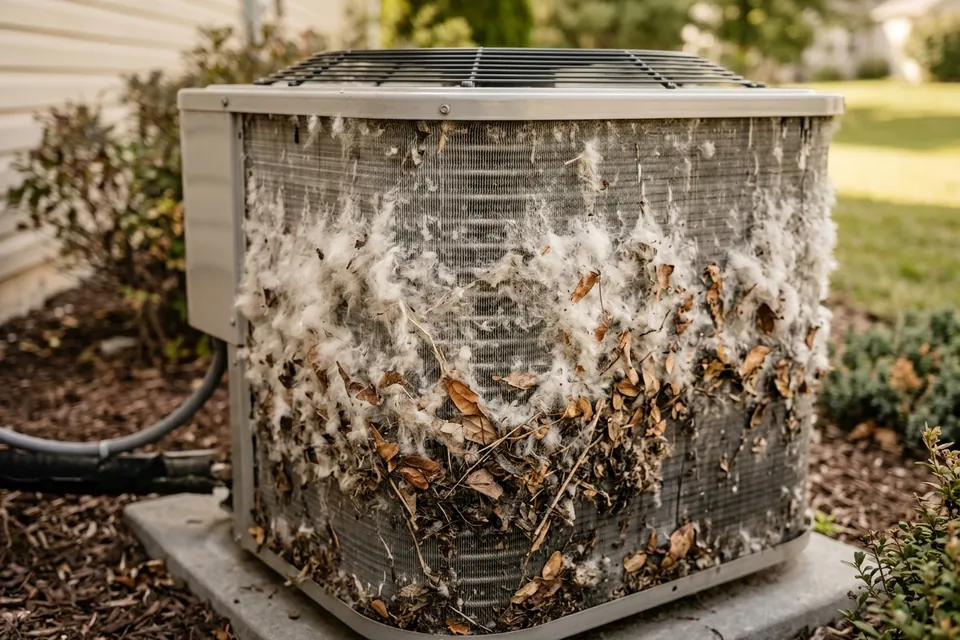
- Step outside to the condenser. You should hear it humming and see the top fan spinning. Clear away leaves, grass clippings, bags or anything leaning on the sides, by hand, with the cabinet left closed.
Thermostat, filter and breaker all fine and the air is still warm? Call a local AC company, then finish the last checks while you wait.
Phone line opening soonHave this ready when you call
- Your address
- What the system is doing (no heat, no cooling, a noise, a leak)
- Roughly how old the unit is
- Walk the rooms. Open any supply vents that got shut and move furniture or rugs off the return grille.
- Check for ice. Frost on the copper line at the outdoor unit, or on the indoor coil cabinet, means the system should rest. Set the thermostat to Off and the fan to On so the ice can melt, and put a towel down for the drip.
Stop and call a pro when
- The breaker trips a second time after your one reset.
- Ice is on the lines or the coil, or it returns after thawing.
- The outdoor fan won't turn, or the unit buzzes, clicks or grinds.
- You smell something burning or see scorch marks near the equipment.
- Every check above passes and the vents still blow room-temperature air.
Anything past this point means opening the equipment, handling refrigerant or testing live electrical parts. Those are jobs for a licensed technician, not for a homeowner with a screwdriver.
Heat in Houston is a safety matter
National Weather Service normals put the July high at Bush Intercontinental at 94.5 °F, and extreme heat is one of the hazards the City of Houston's mitigation plan rates High. A house with no cooling climbs quickly on a day like that. If someone at home is elderly, very young or unwell, move them to an air-conditioned place while you sort out the repair, and call 911 for anyone showing signs of heat illness.
If the whole house is dark
An AC that quits along with the lights is a power problem, not a cooling problem. CenterPoint Energy maintains the lines in the Houston area and takes outage and downed-line reports at 713-207-2222. The electricity itself is billed by whichever retail provider you picked, but delivery faults go to CenterPoint.
Permit and license for the repair
Houston's permit rule reaches further than replacement: the City requires a permit for the installation, repair, or replacement of condensing units, and a contractor has to register a state license with the City before applying. Swapping a thermostat does not need one, according to the City's storm repair guide. Texas requires an air conditioning and refrigeration (ACR) contractor license, issued by the Texas Department of Licensing and Regulation, for anyone who offers this work. You can type a company name into the TDLR License Data Search before the visit. More detail sits on the permits page.
Repair or replace: the national numbers
No verified Houston price for an individual AC repair is listed here (national ranges are below), so ask for the diagnosis and the price in writing before work starts. For scale, Fixr's national range for a new central air conditioner is $5,000 to $12,000 installed. That is a national figure, not a Houston one. The replacement cost page walks through it.
CenterPoint programs worth asking about
If the answer turns out to be a new system, CenterPoint Energy incentives for central A/C, heat pumps and mini-splits start at $200 for equipment rated 15.2 SEER2 or better, credited on the invoice by a participating contractor. CenterPoint's efficiency page also lists a $50 instant rebate on an ENERGY STAR smart thermostat and a free A/C tune-up program for systems at least one year old. Terms apply to each; the incentives page has the conditions.
What a repair usually costs
National ranges from cost publishers, not Houston quotes. The fault decides the price, so ask for it in writing before work starts.
When you call: 4 questions to ask
- Does the Houston Permitting Center permit for the condensing unit come with this price?
- Is the new system at least 15.2 SEER2, and are you a CenterPoint participating contractor for the incentive?
- What's your TDLR air conditioning and refrigeration license number?
- How did you size the unit for this house and our humidity?
A fair written quote shows the equipment and its SEER2 rating, the permit, any CenterPoint incentive taken off the invoice, haul-away and labor warranty. Check any contractor's license on the TDLR license search before work starts.
What happens when you call
- You're connectedStraight to a local heating & cooling pro that serves your area and takes calls like yours.
- You get a priceDescribe the problem, ask for a written quote and their license number. No obligation.
Want a price for your home? Call a local heating & cooling pro for a written quote.
Phone line opening soonCommon questions
Why is my AC running but not cooling the house?
The common homeowner-level causes are a thermostat on the wrong mode, a blocked filter, a tripped breaker for the outdoor unit, or a condenser smothered by debris. If those are fine, the fault is inside the equipment and needs a technician.
Should I turn the AC off if it isn't cooling?
Yes, if you see ice, hear grinding or buzzing, or the breaker has tripped twice. Running it in that state can make the damage worse. Leave the fan on to thaw ice.
Does an AC repair need a permit in Houston?
The City of Houston requires a permit for the installation, repair, or replacement of condensing units, the outdoor part of the system. The contractor applies for it after registering a license with the City.
What license should an AC technician's company hold in Texas?
An air conditioning and refrigeration (ACR) contractor license from the Texas Department of Licensing and Regulation. The TDLR License Data Search lets you look it up.
Related guides
Sources
- National Weather Service: Houston Bush Intercontinental (IAH) normals, July (1991-2020)
- City of Houston Office of Emergency Management: Hazard Mitigation Plan Update (2023-2028)
- Fixr: Air conditioner installation cost (national)
- Houston Permitting Center: Condensing unit permit
- Houston Permitting Center: Storm damage repair permit guide (rev. May 2024)
- Texas Department of Licensing and Regulation: Air Conditioning and Refrigeration at a glance
- TDLR License Data Search
- CenterPoint Energy: Where we serve
- CenterPoint Energy: Reporting an outage or emergency
- CenterPoint Energy: Heating and cooling incentives, Houston Electric service area
- CenterPoint Energy: Residential electric efficiency programs
Costs are typical ranges. Your quote depends on your home. Rules and rebates change; check the original source before you rely on a figure. Something wrong? Tell us via the contact on the Impressum page.